Oldřich Starý
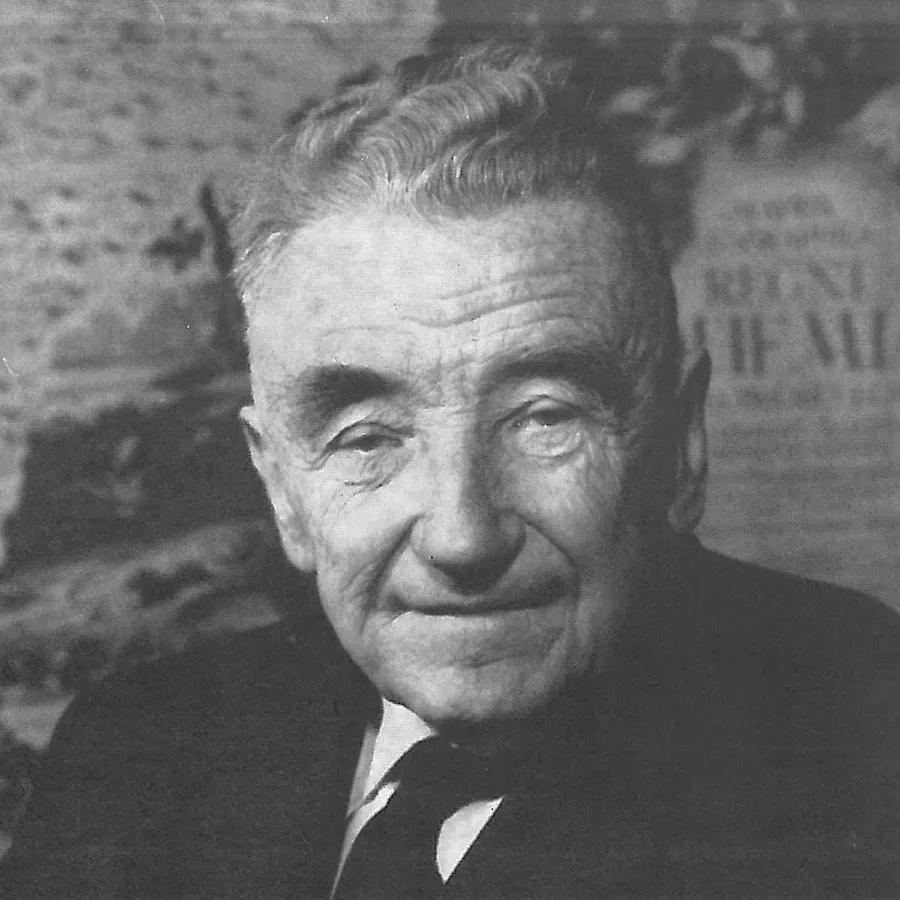
A pioneer of Czech Functionalism, the Prague architect, theorist and teacher Oldřich Starý was one of the leading figures of Czech modern architecture of the interwar period. He systematically promoted the principles of "new architecture", the purity and veracity of forms and especially the conviction that architecture is not art, but "scientifically-based cultural work".
Oldřich Starý began his professional career in 1912 after graduating in architecture from the Czech Technical University in Prague (CTU today), where he studied with the professors Josef Schulz and Jan Koula. In the same year, he began teaching at the Czech State Technical College in Pilsen (the Secondary School for Civil Engineering in Pilsen today), for which, among other things, he designed interior adaptations of the staff room and the principal's office. He worked in Pilsen until 1919, when he was transferred to the same school in Prague. Among his first project tasks were factory buildings in Ejpovice and Srbsko near Karlštejn that – like his early houses in Pilsen-Lochotín and Blatná – still reflect the influence of Art Nouveau. However, relatively soon after the foundation of the new democratic state in 1918, Starý began to strongly criticise the excessive decoration of façades. He considered, among other things, the then debated National Style to be very problematic; its iconic building – the Legiobank building by Josef Gočár – was in his view a mere "epitome of the chaos of our times".
The radical views of Oldřich Starý are best illustrated by his project of an apartment building in Prague-Dejvice from 1923, whose plain smooth façade secured him the reputation of a pioneer of Czech Purism. Additionally, he became, as early as 1922, the president of the Rationally Minded Club of Architects and an editor of the magazine Stavba / Building. The circle of authors around this Functionalist revue included among others Karel Teige, with whom Oldřich Starý was bound not only by a close friendship but also by efforts to suppress the artistic status of architecture, and a complete negation of aesthetics.
These efforts are clearly visible in Oldřich Starý’s villa designs in Brno and Prague’s Hanspaulka and Baba neighbourhoods from the late 1920s and early 1930s, which corresponded with Corbusier’s ideal of a house as a "machine for living". In the context of Oldřich Starý’s work, the palace house on Národní Avenue in Prague stands out, which he designed for the Union of Czechoslovak Work of Art in 1936, of which he was chairman from 1935 on.
After World War II, Oldřich Starý worked as a teacher at the Technical University in Prague, he edited the magazine Architektura ČSR / Architecture of the CSR and was involved in other publications as well – it is worth mentioning the famous book Československá architektura od nejstarší doby po současnost / Czechoslovak Architecture from the Earliest Times to the Present, written in collaboration with the architecture historian Marie Benešová in 1965.
Oldřich Starý died on the 3rd of November 1971 in Prague.
AŠ
Architekt/ka
Oldřich Starý
Date of birth
15.03.1884 Praha
Death date
03.11.1971 Praha
Literature
Marie Benešová. Architekt prof. Dr. h. c. Oldřich Starý. Architektura ČSR XIII. 1954. 4.
Zdeněk Lukeš. Oldřich Starý (1884–1971). Umění a řemesla. 1984. 2.
Rostislav Švácha. Oldřich Starý. Architektura jako kulturní práce. Výtvarná kultura VIII. 1984. 4.
Rostislav Švácha. Od moderny k funkcionalismu : proměny pražské architektury první poloviny dvacátého století. Praha, 1994.
Jaroslava Lencová. heslo Starý, Oldřich. Nová encyklopedie českého výtvarného umění N–Z. Praha, 1995. II. s. 780.
Stephan Templ. Baba. Osada Svazu Čs. díla Praha. Praha, 2000.
Oldřich Starý. Nejmenší dům. Praha, 1931.
Petr Domanický. Plzeň. Průvodce architekturou města od počátku 19. století do současnosti. Plzeň, 2013.
Michal Kohout, Rostislav Švácha. Česká republika – moderní architektura. Čechy. Praha, 2014.