Josef Havlíček
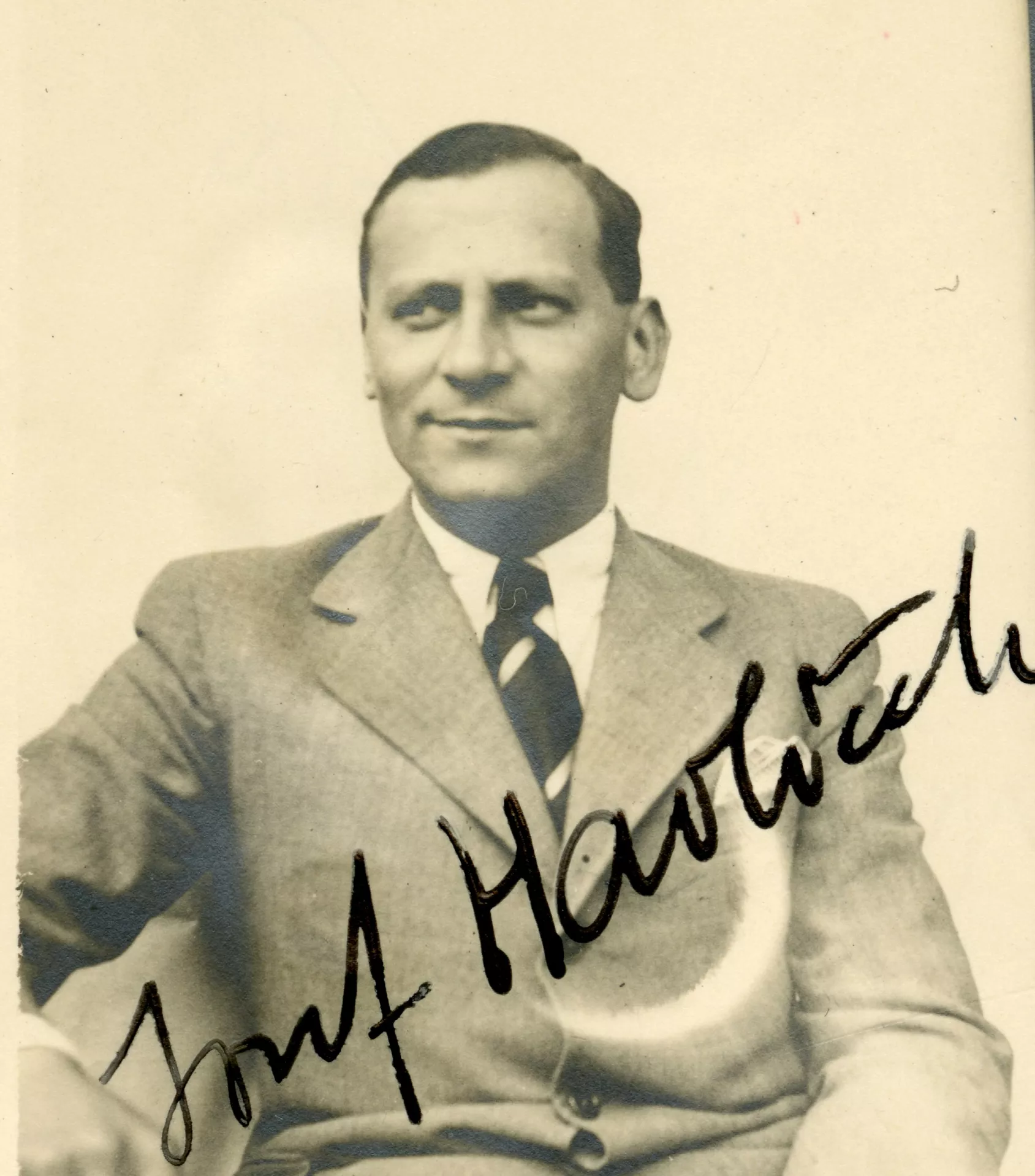


Architect Josef Havlíček was a representative of the most avant-garde trends in interwar architecture and of the great visionary transformation of Prague in a number of modernist utopian projects. Between 1916 and 1924, he studied architecture at the Prague Technical University, and in 1926, at the architectural studio of Josef Gočár at the Academy of Fine Arts. As a student he designed the Czechoslovak border pillars together with Bedřich Stefan. In 1927, he began working with engineer Jaroslav Josef Polívka. Together, they designed the administrative Habich Palace and the Chicago Palace for agrarian entrepreneur Jindřich Kolowrat-Krakowský and they participated in the competition for bridging the Nusle Valley. They designed nine soundproofed residential high-rise buildings supporting a two-lane bridge road. In 1928, Havlíček founded the H & H studio together with Karel Honzík. At that time, he began to be active in artistic and professional organizations: he was a co-founder of the Devětsil association and one of its most important members – architects. He was also a member of the Mánes Union of Fine Artists and the Architects Association. Together with Karel Honzík, Jiří Kroha, Karel Teige and Jiří Voženílek, he was a member of the Left Front association of leftist artists and architects. Havlíček also published articles on collective housing and other topics, like Teige and Honzík. Between 1929 and 1931, he collaborated with Honzík on probably his most important building – the Všeobecný penzijní ústav (General Pension Institute) in Prague–Žižkov, which was a significant gesture of modernism. Later, Honzík expressed his regret they had not paid more attention to the context of the historical panorama of Prague [1]. In the 1930s, Havlíček and Honzík designed several tenement houses in Prague. After their professional break-up, Havlíček designed the concept of the terraced housing estate on Letná Plain, the complex of houses called Molochov. Between 1945 and 1948, he worked on the urbanism of Hradec Králové: first, he designed the regulation of the new development of Slezské Předměstí (Silesian Suburbs); later, he designed the Labská kotlina (Gottwald) district together with František Bartoš, including the standard terraced houses. Subsequently, Havlíček and Bartoš worked on the new regulatory plan of the city, including the broader relations and the creation of the Hradec-Pardubice agglomeration [2]. In 1948, Havlíček became the first director of the Stavoprojekt company. Together with Karel Filsak, he designed the new regulatory plan of Jindřichův Hradec. Later, Havlíček and Filsak collaborated with Karel Bubeníček on the design of the Rozdělov housing estate in Kladno. Havlíček also designed a number of utopian urban designs, including the development of Žižkov and the Pankrác Plain with pyramidal skyscrapers. These fanciful plans never materialized and were difficult to build, but they inspired the development of the Czech avant-garde ideas.
LZL
Notes
[1] Comp. Ladislav Zikmund-Lender, Karel Honzík – památkář? Staletá Praha, vol. 2013, no. 1, pp. 109–113
[2] Comp. Jakub Potůček, Josef Havlíček, František Bartoš - Regulační plán Hradce Králové 1945–1950, in: Magazín UNI, www.magazinuni.cz/architektura/josef-havlicek-frantisek-bartos-regulacni-plan-hradce-kralove–1945–1950/, accessed on 5. 2. 2019
Architect
Josef Havlíček
Date of birth
05.05.1899 Praha
Deceased
30.12.1961 Praha
Literature
Zdeněk Vávra, Radomíra Sedláková. Josef Havlíček: výstava pořádaná k 100. výročí narození českého architekta (kat.). Praha, Národní galerie, 1999.
Dita Dvořáková. Všeobecný penzijní ústav – Dům odborových svazů. Praha 2014. p. 104–106.